Workforce Retirement and the Protection of Water/Wastewater Infrastructure in Texas
Updated: Apr 7
By: David Stone
April 2026
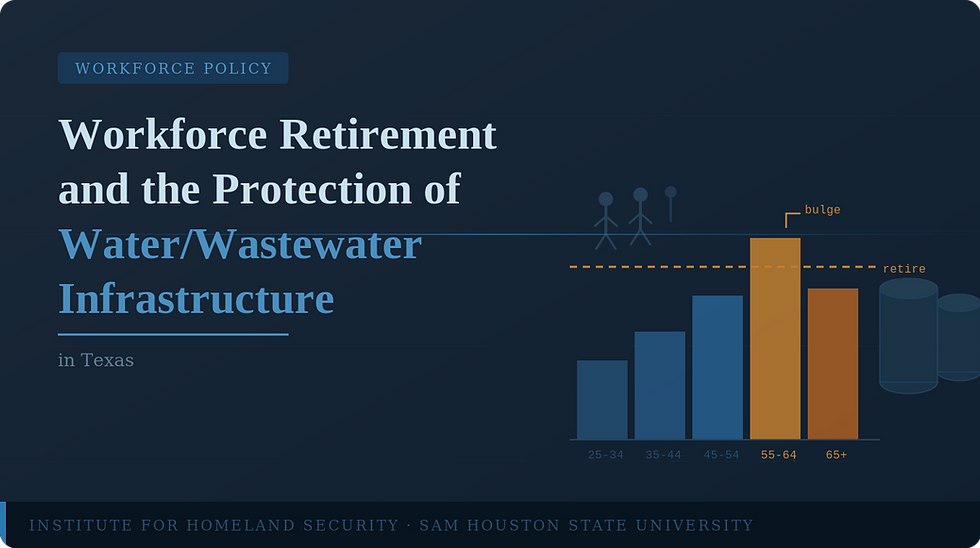
Water and wastewater systems are among the most vital components of critical infrastructure in Texas. They safeguard public health, support the economic growth of one of the fastest-expanding states in the nation, and preserve environmental stability through the treatment and distribution of safe water. Yet while physical infrastructure receives most policy attention, the performance and security of these systems ultimately depend on a skilled workforce capable of operating and maintaining them. That workforce is approaching a period of significant transition. Many operators, engineers, and maintenance professionals employed by Texas water utilities entered the profession during the major infrastructure expansion of the late twentieth century and are now nearing retirement. Industry assessments suggest that a substantial share of the current water workforce is approaching retirement eligibility, creating an urgent need for new workers with comparable skills and knowledge.¹ A survey conducted by the Houston Advanced Research Center on behalf of the Texas Water Foundation found that more than sixty percent of respondents were already experiencing workforce-related challenges, and seventy-six percent identified hiring and retaining qualified employees as a medium-to-high risk to their organizations.² These findings reflect a national pattern in which the median age of water sector employees exceeds that of the broader workforce, indicating that replacement demand will intensify throughout the coming decade.³
The most immediate consequence of these retirements will be sustained pressure on Texas utilities’ ability to maintain day-to-day operational reliability. Water and wastewater systems depend on experienced operators to monitor treatment processes, manage chemical dosing, test water quality, and respond to system anomalies. Even minor operational errors can introduce contamination risks or trigger regulatory violations under the Safe Drinking Water Act and the rules administered by the Texas Commission on Environmental Quality. The retirement wave also threatens to erode a form of institutional knowledge that is difficult to replace. Water utilities rely heavily on tacit knowledge that develops through years of direct experience with specific treatment systems, infrastructure layouts, and local environmental conditions. Veteran employees recognize subtle patterns in equipment behavior, recall the history of maintenance decisions, and rely on informal troubleshooting techniques that are rarely documented in written procedures. When large numbers of these workers retire within a short period, utilities risk losing a critical reservoir of operational insight. The result may be slower problem solving, greater uncertainty during emergencies, and reduced capacity to anticipate system failures.
This loss of expertise has particular implications for infrastructure protection in a state as geographically and climatically varied as Texas. Water systems must remain resilient against contamination events, extreme weather, infrastructure deterioration, and operational disruptions. The vulnerability of Texas water infrastructure to severe weather was underscored by the winter storm of February 2021, which exposed weaknesses in the state’s preparedness and response capacity. During such emergencies, experienced operators and supervisors serve as the frontline of diagnosis and recovery, and act decisively under uncertain conditions. If that depth of expertise leaves the workforce faster than it can be developed in a new generation, Texas utilities may face longer recovery times and greater vulnerability at precisely the moments when reliability matters most.
The retirement trend is also likely to affect different Texas utilities unevenly. Large metropolitan systems in cities such as Houston, Dallas, San Antonio, and Austin generally maintain deeper staffing pools, stronger training programs, and greater financial resources for recruitment. Smaller utilities, particularly those serving rural communities, often operate with minimal staffing and constrained budgets. They already face persistent difficulty attracting qualified workers because salaries tend to be lower and career advancement opportunities are more limited. In these settings, the retirement of even one or two experienced employees can disrupt operations. Research on workforce readiness confirms that education and training pipelines in Texas and nationally have not consistently produced enough candidates with the technical skills the sector requires. Recent scholarship suggests the problem extends beyond simple shortages and includes systemic disconnections across the academic, regulatory, professional, and skilled-trade pathways that shape the water workforce.⁴ Without targeted programs to address these structural gaps, the resulting skill deficits could increase the likelihood of compliance challenges and operational disruptions, particularly in communities with the fewest resources to absorb them.
The retirement crisis extends even to leadership. Many senior managers and technical supervisors in the state’s water sector belong to the same aging workforce cohort. Their departure may create gaps in strategic planning, regulatory compliance, emergency coordination, and long-term infrastructure investment decisions that are difficult to fill without well prepared successors. This concern is especially pressing in Texas, where rapid population growth is placing increasing demands on water systems that must expand capacity while replacing an aging workforce. The cumulative effect of these challenges has direct implications for infrastructure protection. A workforce transition that outpaces the sector’s ability to train and integrate new talent could erode its capacity to maintain consistent operational standards and respond to emerging threats. Infrastructure resilience depends as much on workforce replacement and knowledge retention as it does on the capital investments the state has begun to pursue through measures such as the Texas Water Fund.
Several policy and management approaches can help mitigate these risks. Succession planning allows utilities to identify critical roles, cultivate internal candidates for leadership, and establish mechanisms for transferring knowledge from experienced employees to those who will follow them. Cross-training strengthens organizational resilience by ensuring that multiple staff members understand key operational processes rather than concentrating that knowledge in a single individual. Workforce development partnerships between Texas utilities, community colleges, and technical training programs can create clearer pathways into water sector careers. Institutions such as Texas A&M University–San Antonio have already begun developing post-secondary programs in water resources science and technology that align academic preparation with the practical demands of the industry.⁵ Knowledge management practices can also reduce risk. These practices include documenting operational procedures, capturing lessons learned from veteran staff, and creating mentoring programs that connect generations of workers and preserve critical information when employees retire.
In the coming decade, the water and wastewater sector in Texas will likely undergo one of the most consequential workforce transitions in its history. The retirement of a large share of experienced personnel presents serious challenges for utilities responsible for critical infrastructure in a state defined by growth, geographic diversity, and increasing water demands. With proactive planning and sustained investment in workforce development, however, this transition can become an opportunity to strengthen the next generation of water professionals. Preparing them with the training, mentorship, and institutional support required for public health and environmental protection will be essential. The reliability and security of the state’s water infrastructure will ultimately depend on whether the sector rises to meet this moment.
Sources:
¹ Walter Den and Davida S. Smyth, "How Texas Could Lead the Nation in Addressing a Growing Water Workforce Problem," Texas Water Journal 16, no. 1 (2025): 80–92.
² Houston Advanced Research Center, Workforce Concerns in the Texas Water Industry (Austin: Texas Water Foundation, 2023).
³ Joseph W. Kane and Adie Tomer, Renewing the Water Workforce: Improving Water Infrastructure and Creating a Pipeline to Opportunity (Washington, DC: Brookings Institution, 2018).
⁴ Michel Kordahi and Amal Bakchan, "Shared Failures: Uniting Four Career Pathways to Overcome Decentralized Wastewater Workforce Challenges in Limited-Resource Rural Communities," ACS ES&T Water 5 (2025): 7475–7491.
⁵ Rudolph A. Rosen et al., "Water Security for Texas: A Post-Secondary Education Pathway for Water Workforce Readiness," Texas Water Journal 9, no. 1 (2018): 120–128.